Monday, December 24, 2012

My top movies of 2012


I watched some great movies in 2012.

Here is the list of top 5:

#5: The Best Exotic Marigold Hotel
#4: Awakenings
#3: The Pianist
#2: People Like Us
#1: One Flew Over the Cuckoo's Nest

My top books of 2012


I read many great (and some not so great) books in 2012.

Here are my top 5 books:

#5. Steve Jobs
#4. The Hiding Place
#3. Real Marriage
#2. How Will You Measure Your Life?
and
#1. Changes That Heal

Monday, November 26, 2012

Understanding the TSAM REST API

The TSAM REST API is only briefly documented in the product documentation. However, there is a Redbook that goes through an extensive explanation of the mechanics of the API.

Look at Section 12.5 of the following document:

http://www.redbooks.ibm.com/abstracts/sg247878.html?Open

What are the roles in Tivoli Service Automation Manager?

TSAM defines the following roles:


Table 1. Roles and groups provided by Tivoli Service Automation Manager
Role Description Person Group (8 chars) Role (10 chars) Security Group (must be created in LDAP)
Service Administrator TSAMSADM PMZHBSADM PMZHBSADM
Service Definition Designer TSAMSSDD PMZHBSSDD PMZHBSSDD
Service Definition Manager TSAMSSDM PMZHBSSDM PMZHBSSDM
Service Deployment Instance Manager TSAMSSIM PMZHBSSIM PMZHBSSIM
Service Deployment Instance Operator TSAMSSIO PMZHBSSIO PMZHBSSIO
Service Resource Allocation Manager TSAMSRAM PMZHBSRAM PMZHBSRAM
       
WebSphere Cluster Service      
Performance - AIX® Administrators TSAMPAXA PMZHBPAIXA PMZHBPAIXA
Performance - WAS Administrators TSAMPWAS PMZHBPWASA PMZHBPWASA
Performance - Linux Administrators TSAMPLXA PMZHBPLNXA PMZHBPLNXA
Performance Monitoring Administrator TSAMPPMA PMZHBPPMA PMZHBPPMA
       
       
Self-Service Virtual Server Provisioning component
Tivoli Service Automation Manager Administrator (for Self-Service Virtual Server Provisioning) Not applicable PMSCADMUSR PMSCMADMUSR
Service Definition Manager
The Service Definition Manager role is designated for users who are responsible for triggering and tracking new service definitions. This role is also responsible for assigning the tasks for new definitions to designers, and to approve designed service definitions for instantiation.
Service Definition Designer
The Service Definition Designer role is designated for users who are responsible for creating new service definitions when instructed to do so by a service manager.
Service Deployment Instance Operator
The Service Deployment Instance Operator is designated for users who are responsible for instantiation of designed and approved service definitions. These users operate service instances, such as starting a job plan.
For self-service offerings, users assigned to this group are authorized to troubleshoot unexpected problems that arise with the automated fulfillment of service requests submitted by members of the PMRDPUSR (Offering Catalog user) group.
Service Deployment Instance Manager
The Service Deployment Instance Manager role is designated for users who are responsible for controlling and approving the execution of service instances.
Service Resource Allocation Manager
The Service Resource Allocation Manager role is designated for users who manage the allocation of resources (CIs) to service instances. For example, servers that are represented in CIs can be allocated to a specific instance.
Service Administrator
The Service Administrator role is a 'super user' for all aspects of service definitions and instances. This user has the authority to exercise all the functions of a Service Deployment Instance Manager, Service Deployment Instance Operator , Service Definition Designer, and Service Definition Manager.
For self-service offerings, the administrator performs a series of tasks that set up the applications to enable service requesters to initiate and manage the requests. This administrator also manages the offering catalog.
Performance: AIX Administrators
Users in this role are responsible for all kinds of performance and problem determination tasks related to AIX systems.
Performance: WAS Administrators
Users in this role are responsible for all kinds of performance and problem determination tasks related to WebSphere systems.
Performance: Linux Administrators
Users in this role are responsible for all kinds of performance and problem determination tasks related to Linux systems.
Performance Monitoring Administrator
Users in this role are responsible for all kinds of problem determination tasks. They have the authority to perform all tasks that are defined in the performance and problem determination tasks.
Tivoli Service Automation Manager Administrator (for Self-Service Virtual Server Provisioning)
Users in this role perform various administrative tasks that are available only in the administrative interface, such as managing the offering catalog for the Self-Service Virtual Server Provisioning component.

(http://pic.dhe.ibm.com/infocenter/tivihelp/v10r1/topic/com.ibm.tsam_7.2.4.doc/c_security_roles.html)

Tuesday, February 28, 2012

How to add additional JAR files to be used in an Automation Script in tsrm

If you want to use additional Java libraries in your Automation Script, you need to add the corresponding JAR files to the MANIFEST.MF, located at:

/opt/IBM/WebSphere/AppServer/profiles/ctgAppSrv01/installedApps/ctgCell01/MAXIMO.ear/maxrestweb.war/META-INF

Then restart WebSphere to pick up your change.

Wednesday, December 8, 2010

Is CMDB the end of the line?

Recently, I have been working with my colleagues in integrating a CMDB with other ITIL processes. We discussed with the CMDB vendor about how we could extract data from it, and the answer was there was no way, and the CMDB is considered the end of the line (not life!).

I spent years talking about (and implementing) CMDB solutions at many customers. We discussed data integration, federation, reconciliation and many other aspects. In many cases, after a long time implementing it, we'd look at a perfect CMDB without a clear understanding on what we would be doing with it.

I understand CMDB is intended to gather data from different sources and is the cornerstone of the ITIL processes. Ideally these ITIL processes would leverage the data in CMDB, without replicating it. The reality thou is different: in many cases, some data need to be extracted from CMDB and loaded into another product (whether from the same vendor or not).

At IBM, we've built the ITIL processes on same platform (Tivoli Process Automation Engine) as the CMDB. Nevertheless, we provide many different ways to extract from (and load into) Tivoli Change and Configuration Management Database (CCMDB).

If your CMDB vendor doesn't provide a way to extract data, my challenge to you is to describe what are the use cases you're planning to use the CMDB for. My opinion: building a CMDB should not be the target, but just the catalyst of a Service Management initiative.

Thoughts? Am I missing anything?

Friday, September 24, 2010

How to pass the subnetworking to be used in a TSAM provisioning

After enabling the parameters in the TSAM GUI, as described at

http://eduardoware.blogspot.com/2010/09/how-to-expose-parameters-in-tsam.html

and setting the multiple NIC support, as described at:

http://eduardoware.blogspot.com/2010/09/how-to-enable-multiple-nic-interfaces.html

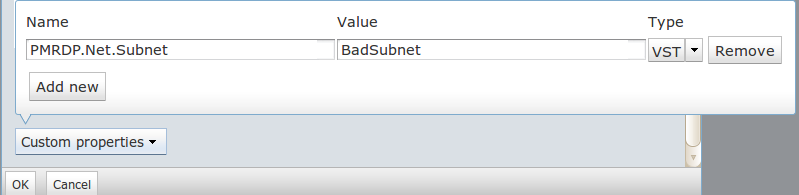
then create a new Custom Property, as depicted below:


Remember to set the type to VST.

Furthermore, the proper name of the Property is PMRDP.Net.Subnet_0

How to enable multiple NIC interfaces in TSAM

  • Go To -> Administration -> Provisioning -> Provisioning Global Settings 
  • Search for the following property


PMRDP.Net.MultiNicSupport

and set its value to true.

How to expose parameters in the TSAM SimpleSRM interface

TSAM provides the capability for the end-user to select CPU, memory and disk size, along with which Resource Pool, Image and additional Software to install. Besides that, it's possible to expose any internal parameter in the GUI, opening opportunity for the user to specify values for internal properties.

One use case for this feature is the ability to select which VLAN the VM should be allocated.

The following steps show how to expose the parameters in the GUI (as tioadmin):


  • Stop TSAM/TPM
    cd /opt/IBM/tivoli/tpm/tools/
    ./tio.sh stop
  • Create a temporary directory
    mkdir ~/temp
    cd ~/temp
  • Copy SRMCommons.jar to the new directory
    cp /opt/IBM/WebSphere/AppServer/profiles/ctgAppSrv01/installedApps/ctgCell01/MAXIMO.ear/SRMCommons.jar .
  • Open the JAR file
    /opt/IBM/WebSphere/AppServer/java/bin/jar xvf SRMCommons.jar
  • Edit the config.properties
    vi ./com/ibm/tivoli/simplesrm/configuration/config.properties
  • Search for property ParameterPassing, set it to true:
    #If "true" - passing parameter button is visible in Create and Add panels.
    ParameterPassing=true
  • Rebuild the JAR file
    /opt/IBM/WebSphere/AppServer/java/bin/jar cvf SRMCommons.jar .
  • Copy the new JAR file to the WebSphere directory (you might want to keep a copy of the original JAR file to revert back to the original GUI):
    cp SRMCommons.jar /opt/IBM/WebSphere/AppServer/profiles/ctgAppSrv01/installedApps/ctgCell01/MAXIMO.ear/SRMCommons.jar 
  • Restart TSAM/TPM:
    cd /opt/IBM/tivoli/tpm/tools/
    ./tio.sh start
  • You'll see a new area at the bottom of the Create Project with Server option:
  • Clicking the Custom properties button, you'll be able to add any parameter to the Virtual Server Template.

Thursday, September 23, 2010

How to start TDS in a TPAE environment

/opt/IBM/ldap/V6.2/sbin/ibmslapd -I idsccmdb

Thursday, August 19, 2010

Virtualization with VMware and IBM: Enjoy the Ride, but Don’t Forget to Buckle Up!

Good VMware / IBM Security presentation. Recorded session available:

Virtualization with VMware and IBM: Enjoy the Ride,
but Don’t Forget to Buckle Up!
Thursday, August 5, 2010, 9:00 AM PDT / 12:00 PM EST


Organizations are under increasing pressure to deliver more functionality to their businesses and customers. At the heart of this transformation is virtualization. However, the ultimate success of virtualization is not simply dependent on energy efficiency, performance and ease of use. It must also provide these benefits without compromising the overall security, reliability and availability of the IT infrastructure.

Join VMware and experts from IBM Security as we examine many of the concerns associated with virtualization and help organizations better understand and prioritize these risks, as well as help you build a strong security posture that will positions your organization to reap the full rewards of this exciting technology.

View this webcast to find out about:
Involving the IT security team in the initial stages of virtualization projects
Maintaining compliance when adopting a virtualization solution
The limitations of traditional security in virtual data centers and how to mitigate security risks

Featured Speakers:
Bob Kalka, Director, Security Solutions, IBM
Ravi Kumar, Group Product Marketing Manager – Security, VMware

Register today!

TDI 7.1 - DLA video and write-up

Hot off Eddie's press. The old material we had on this was pre-Eclipse and older IdML components

This is becoming real smooth :)

Video: http://www.youtube.com/watch?v=ZIMhQRtB2T0

Here is the latest version of the PDF:
http://www.tdi-users.org/twiki/pub/Integrator/IsmPage/GettingStartedcreatingIdMLDiscoveryBooksDLAswithTDI7.pdf

Wednesday, May 12, 2010

Integrating TADDM with BMC Atrium

We got competition!

There is a company that releases a way to integration TADDM with BMC Atrium. See information at: http://www.seamlessti.com/ibm_taddm_cmdb.html

It seems it connects to the TADDM database, instead of using the TADDM API. Suspicious...

Friday, April 23, 2010

The power of a single Service Management platform

When IBM acquired MRO and decided to build many Service Management products on the top of the Maximo platform, it certainly benefited from the same GUI, lots of common functionality (Integration Framework, Escalation, Security model, to name a few).

However the main benefit of putting all these products (CCMDB, TSRM, TAMIT, TPM) on the top of the Tivoli Process Automation Engine (TPAE) platform is the fact that the data is shared among all the products. So instead of having to push CMDB data into a Service Desk tool or push Incidents to a CMDB, the TPAE platform holds the data once for all these applications to use.

I can't think a better way to build a CMDB-centric ITIL implementation that having all ITIC processes sharing the same data. The alternative is to push CMDB data into a Service Desk tool, an Asset Management tool, and so on, making the project focus on data shuffling.

The benefit is that, using an IBM-based solution, the ITIL implementation can evolve from starting with one ITIL process to the next one, and the task is to install and configure the ITIL Process Management, not to be concern about how to move data around.

Thoughts?

How Tivoli Directory Integrator can be used in the federation of a CMDB

Tivoli Directory Integrator is a fantastic and flexible data integration tool that can be used efficiently in implementing the data federation in a CMDB.

IBM's approach for CMDB federation is based on an XML file that complies to an XML schema called Identity Markup Language. TDI is a great and simple way to generate these XML files, as it abstracts all the nuances of the XML file into CI types and attributes. This video shows how easy it's to create this IDML file.

The power of TDI thou doesn't come from the IDML Connector, but it comes from the plethora of available connectors (JDBC, JMS, Notes DB, Web Service, HTTP, to name a few) and the flexibility it provides to connect many data sources without the need to write a single line of code. Want to create an IDML with just the data that changed since last time? You got it. In TDI, it's just a few click away, just the Delta capability.

Another interesting aspect is that there are other TDI connectors available in the CMDB / Service Management space: the Maximo Generic Connector let us interface with CCMDB without having to generate an IDML file, but going through Tivoli Integration Framework. The TADDM Connector lets you create (and retrieve) CI from TADDM, which will be imported into CCMDB.

Questions? Comments?

Federation and reconciliation goes hand-in-hand in a CMDB implementation

When we talk about federation in a CMDB implementation, it's because there are multiple data sources that need to be combined as a single repository (even if the data is not physically combined into one single database).

Having multiple data sources implies that they will many times refer to the same Configuration Item, raising the question of how to reconcile these records. Traditionally, CMDB products chose a primary key that is used to merge the data; however, my experience shows it's difficult to identify a single attribute that can be universally to identify a CI type. As an example, although a computer serial number might seems a good candidate, we have seen that many products don't provide such attribute, but relies on IP address as the identifier. The same argument can be used for IP address and any other attribute.

At IBM, we decided to take a different approach: instead of relying an attribute or a collection of attributes to uniquely identify a CI, we have defined many naming rules for each CI types and enforce that each data source provides the attribute of at least one rule. So if a product uses serial number to identify a CI, another uses serial number and IP address, and a third one, just IP address, this ingenious approach will be able to determine when they represent the same CI.

So the integration with IBM CCMDB is based on having products providing data according to a common data model  in a process named Discovery Library Adapter.

The alternative of implementing this federation / reconciliation approach is to defer the reconciliation of the data instead of doing it before the data is imported into a CMDB. Some products define the concept of many buckets of data that are combined through a reconciliation mechanism. Although this approach simplifies the data loading process, it defers to the user the responsibility of federating and creates another hop in the data chain.

Next we'll talk about how we can use Tivoli products to assist in federating the data into a CMDB.

Federation capability on CMDB

Since the inception of a Configuration Management Database concept, there has been this notion that CMDB needs to be a federated solution. But what qualifies a federation, as the term is certainly overused and stretched in many directions.

Here is wikipedia.org definition of IT Federation:

A Federation is multiple computing and/or network providers agreeing upon standards of operation in a collective fashion. The term may be used when describing the inter-operation of two distinct, formally disconnected, telecommunications networks that may have different internal structures. The term may also be used when groups attempt to delegate collective authority of development to prevent fragmentation.


Well, it doesn't tell a lot, except it says about multiple computers working together. I see two distinct ways to achieve such interoperability:


  • data integration, traditionally called ETL (extract, transform and load), where data from a data source is physically moved to another data source. A data integration has the benefits of all the data will be concentrated into one single repository, which addresses an intriguing question about a CMDB: without bringing the data together, how can we build a CMDB if the data sits in an external data without any kind of Change Management process to update it?
  • use tools, like IBM InfoSphere Federation Server to portrait the data as a single repository, even if it resides physically in many data sources. The main advantage of this approach is the fact that the data doesn't need to be synchronized and it's retrieved only when needed. It creates the issue of how to keep track of CMDB changes when there are many data sources, and the associated products are updating the data sources at their own will.

My recommendation for a CMDB is to have a balance between data integration and real-time federation, where the key attributes of brought to a centralized database and unsupervised or volatile attributes are kept in their original data sources.

Next I will talk how reconciliation is related to federation and CMDB.